
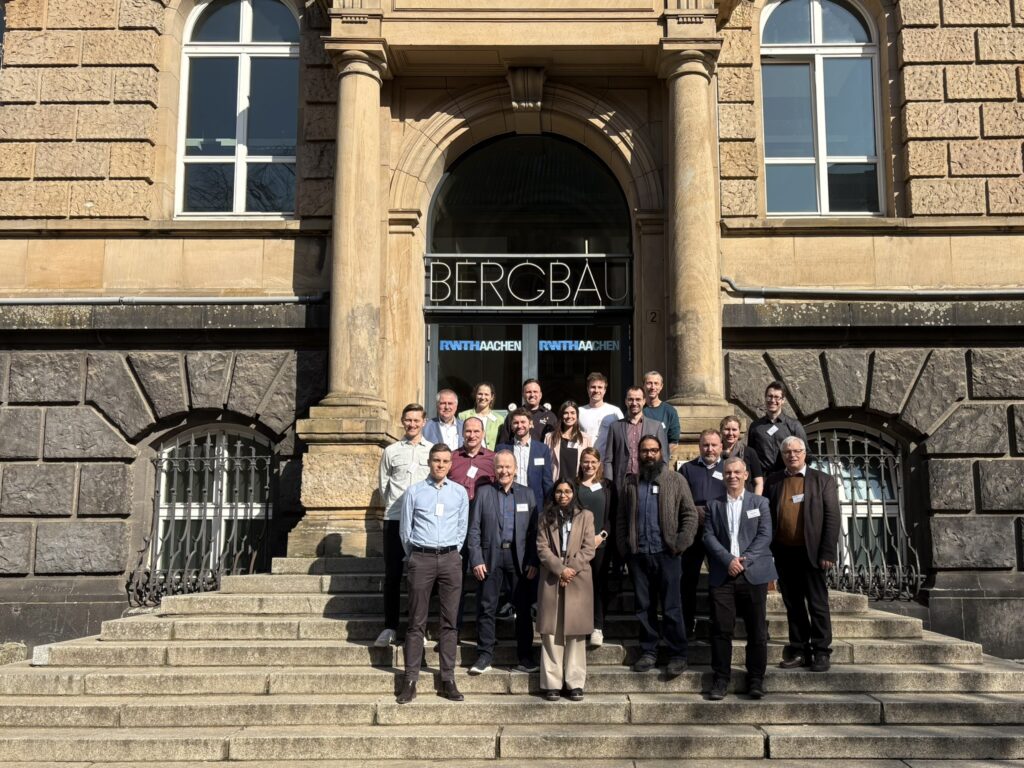
On 4 March 2026, partners from across the research and industry landscape gathered at RWTH Aachen University for the kick-off of Klär-vision, a new BMWE-funded collaborative project running through to the end of 2028. The meeting was well-attended and energetic, bringing together more than a dozen partners — from plant engineering firms to operators of full-scale sewage sludge incineration facilities — and it set a genuinely collaborative tone for the work ahead. For us at the Chair of Energy Process Engineering (EVT) at Friedrich-Alexander-Universität Erlangen-Nürnberg, the project is a direct continuation of our previous work under ProKläR-mission (2023–2025), where we laid important groundwork in process optimization and nitrous oxide reduction in stationary fluidized bed combustion.
The central technical challenge Klär-vision addresses is one that has long constrained operators of sewage sludge incineration plants: agglomeration in the fluidized bed to which the consequences can range from process instability to unplanned shutdowns. Managing this risk has historically meant keeping combustion temperatures conservative — but higher temperatures are precisely what is needed to reduce emissions of nitrous oxide (N₂O), a greenhouse gas roughly 270 times more potent than CO₂. Klär-vision tackles this conflict by advancing the online agglomeration monitor developed in ProKläR-mission into an AI-driven early warning system, fed by real-time sensor data pooled from both laboratory rigs and industrial plants across the consortium. Our specific contribution at EVT focuses on the systematic investigation and optimization of countermeasures — the practical response strategies that operators can deploy the moment the system flags an emerging problem.
What makes this project particularly exciting is that the outcomes are designed to be implementable in existing plants without wholesale redesign. The strength and diversity of the project consortium gives us confidence that the data foundation will be robust enough to produce findings that hold across different plant configurations and operating conditions, not just in our own lab. We thank all the contributors for the successful Kick-off meeting in Aachen and look forward to a wonderful scientific exchange.