
BMLEH-Project: Flex2Biomethane – Catalytic direct methanisation and product gas recirculation into the fermenter to increase the flexibility of biogas plants: Conceptual optimisation and evaluation of economic viability and practical feasibility
The aim of the BMLEH project “Flex2Biomethane” is the conceptual, process engineering and economic optimisation of the concept of flexibilisation of biogas plants through catalytic direct methanisation and product gas recirculation into the fermenter, as well as the evaluation of practical feasibility at existing biogas plants.
Support code: 2224NR061B
Term: 01.10.2025 – 30.09.2027
Fachagentur Nachwachsende Rohstoffe e.V.
Federal Ministry of Agriculture, Food and Regional Identity


Due to the increasing expansion of renewable energies, the German electricity supply system is undergoing a period of transition. Germany’s future energy system will be based on fluctuating renewable energies, primarily wind and solar energy, which will create an increasing demand for flexible and controllable generation plants. Flexible biogas plants offer one way of balancing out fluctuating generation. In the successfully completed project “FlexBiomethane”, the Technical University of Ingolstadt, the Friedrich-Alexander University of Erlangen-Nuremberg and regineering GmbH have already developed an innovative approach to increasing the flexibility of biogas plants. Biogas is continuously extracted from the fermenters/biogas storage tanks, the CO2 contained in the biogas is converted into methane using hydrogen produced from surplus electricity, and then returned to the fermenter. The methane content in the existing biogas storage tank is continuously increased, while at the same time the fermenter is heated by returning the hot product gas from the methanisation reactor and the substrate in the fermenter is mixed. As a result, both heating and stirring energy can be saved. Catalytic direct methanisation and product gas recirculation into the fermenter thus enable the storage of surplus electricity and its feed-in into the power grid as required. Product gas recirculation allows the methane content in the biogas storage tank to be increased to up to 85–90 vol.%. The FlexBiomethane project successfully demonstrated the basic functionality of the concept, but also raised a number of questions that are very important for the commercial implementation of the project.
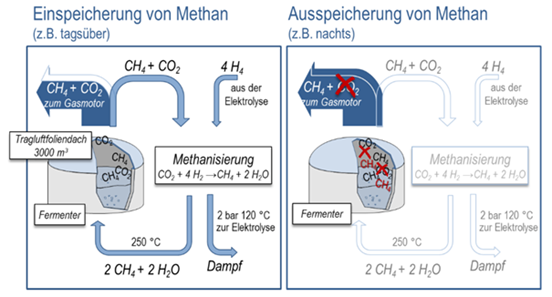
Building on FlexBiomethane, the follow-up project Flex2Biomethane will focus on conceptual, procedural and economic optimisation of the concept with a view to achieving electricity grid-compatible, economical and efficient operation and the practical implementation of the concept for direct methanisation and recirculation of the product gas into the fermenter.
Once the research project has been successfully completed, all the necessary energy, economic, ecological and legal information will be available to implement the concept at a real biogas plant.
Contact person: